
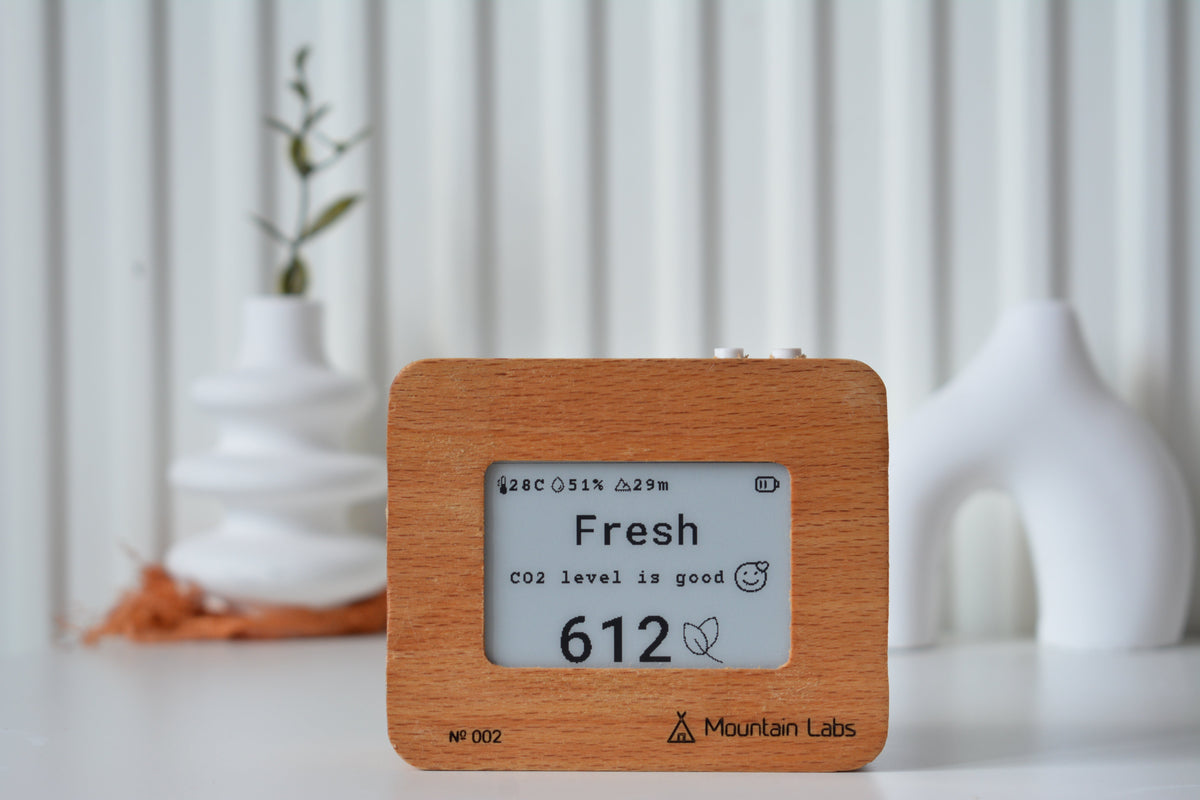
The best home CO2 monitor is the one with a real NDIR sensor and an alert that reaches you in the room where the air is going bad. Everything else (the app, the graphs, the integrations) is secondary to those two things.
We make an air quality monitor, so read this with that in mind. We have tried to write the guide we would want to read before buying one, including the cases where something other than ours is the better pick.
CO2 is the easiest indoor pollutant to ignore. It has no smell, it builds slowly, and by the time a bedroom or home office feels stuffy you have usually been breathing poorly ventilated air for an hour. A good monitor turns that invisible slope into something you notice, and then tells you what to do about it.
What CO2 levels actually mean
Outdoor air sits at roughly 420 ppm. Indoors, CO2 rises with every person breathing in a closed room, so it works as a ventilation gauge: high CO2 means stale air is not being replaced.
|
CO2 (ppm) |
What it means |
What to do |
|---|---|---|
|
400–800 |
Well ventilated, close to outdoor air |
Nothing |
|
800–1,000 |
Air is starting to go stale |
Crack a window if people are staying |
|
1,000–1,400 |
Stuffy; many people notice drowsiness and weaker focus |
Ventilate now |
|
1,400–2,000 |
Poor ventilation, common in closed bedrooms overnight |
Open windows, run ventilation, step out |
|
2,000+ |
Very poor |
Ventilate immediately and find the cause |
These bands are practical guidance, not legal limits. Most building standards and ventilation guidelines treat around 1,000 ppm as the point where a room needs more fresh air, and that is a sensible default alert threshold for a home.
One caveat worth knowing: cheap monitors often show "eCO2", an estimate calculated from a VOC sensor. It can be wildly off. Only an NDIR (non-dispersive infrared) sensor measures CO2 directly, and it is the first thing to check on any spec sheet.
What makes an alert "smart"
"Smart alerts" usually means a push notification on your phone. That is one kind of alert, and not always the most useful one. A notification about your bedroom arrives while your phone is face down on the nightstand; a chime in the room does not.
A genuinely smart alert does five things:
- Fires on a real measurement. An alert built on an eCO2 estimate is a smart alert about the wrong number.
- Reaches you where the problem is. In-room sound or a clear on-device signal works when your phone is elsewhere; phone notifications work when you are away from home.
- Tells you what to do. "CO2 1,240 ppm" is data. "Open a window" is help.
- Knows when to stay quiet. Sensible thresholds, a way to mute it, and no alarm for every brief spike when someone walks past.
- Keeps working. An alert that depends on a company's cloud stops when the service does. Monitors from discontinued product lines have shown this is not a hypothetical.
Which of these matters most depends on where you will use it. For a bedroom or home office, in-room alerts and clear advice matter most. For keeping an eye on a home while you travel, phone notifications win.
The shortlist
Four monitors cover almost every home need. All use real NDIR CO2 sensing; they differ mainly in how they alert you and what else they measure.
|
Monitor |
Best for |
Measures |
How it alerts |
Trade-off |
|---|---|---|---|---|
|
Odak (Mountain Labs) |
Aranet4-class CO2 accuracy plus particles and VOCs, in one portable unit |
CO2, PM1.0, PM2.5, PM10, VOCs, temperature, humidity, pressure |
85 dB in-room alarm + on-screen action ("open a window") |
Rechargeable, so roughly a week per charge rather than years; no phone notifications today |
|
CO2 on its own, with multi-year battery life |
CO2, temperature, humidity, pressure |
Optional beep, Bluetooth app |
CO2 only; blind to smoke, dust and VOCs |
|
|
Airthings View Plus |
The most complete sensor set, incl. radon |
Radon, PM2.5, CO2, VOCs, temperature, humidity, pressure |
Phone app notifications, display |
Full experience needs the app and cloud account |
|
Qingping Air Monitor (Pro / CO2) |
Apple Home and smart-home automations |
Varies by model; check for NDIR CO2 |
App, HomeKit automations |
Some models estimate CO2; the app has been buggy for some reviewers |
Odak vs Aranet4, head to head
The Aranet4 is the monitor most CO2 guides recommend, so it is the fair one to measure against. On the thing that matters most, the CO2 reading itself, the two are level: both use NDIR sensors with an accuracy spec built on ±3% of reading. Both are pocketable, battery-powered and use e-ink.
|
|
Odak |
Aranet4 Home |
|---|---|---|
|
CO2 sensor |
NDIR |
NDIR |
|
CO2 accuracy (spec) |
±3% of reading |
±30 ppm + 3% of reading |
|
Particles (PM1.0 / PM2.5 / PM10) |
Yes |
No |
|
VOCs |
Yes |
No |
|
Display |
E-ink |
E-ink |
|
Power |
Rechargeable, ~7 days per charge |
2 × AA, years per set |
|
Size |
95 × 75 × 30 mm |
70 × 70 × 24 mm |
|
In-room advice |
Tells you what to do (open a window, wear a mask) |
Shows the reading and a colour band |
|
Price |
$279 |
around $189 |
The difference is what each one sees beyond CO2. A room can have perfect ventilation and still be full of cooking smoke, wildfire haze or dust; the Aranet4 will read green through all of it. Odak catches both. The Aranet4's real advantage is battery life, which makes it the better pick if you want something to throw in a bag and forget for years.
If radon is a concern where you live, the Airthings View Plus is the one to get. If your home already runs on Apple Home, a Qingping model with NDIR CO2 slots in neatly.
Where Odak fits
Odak is for people who want to know what they are breathing in the rooms they actually live in, and want that answer on a shelf, not buried in an app.
It tells you what to do, not just what the number is. Most monitors stop at the reading. Odak pairs the air state with an action. "Clean, all is well" when the room is fine. "Stuffy, open a window" when CO2 builds up overnight. "Dusty air, wear a mask, turn on your purifier" when cooking smoke or city dust climbs. You glance, you act, you get on with your day.
It shows you the pattern. One reading tells you about right now. The 24-hour graph shows the bedroom that peaks at 4 a.m. every night, and the three-day report breaks down how many hours you spent in clean, normal and polluted air. That is usually where the real fix appears: open the window before bed, not after waking up groggy.
It turns better air into a habit. Every day Odak scores your air as 100 minus the day's average AQI. Points add up across six levels, from Breeze Seeker to Highlander. It is a small thing, but it turns "I should ventilate more" into something you keep doing.
It is made to be lived with. The front is beech wood, CNC-machined in our workshop and finished with VOC-free natural oil, so no two units share the same grain. The e-ink screen reads like paper and gives off no light, so nothing glows on your nightstand. It is small enough to carry from desk to bedroom to hotel room, and runs about a week per charge.
What it does not do. Odak has no phone notifications today. If you need to check your living room's air from the office, Airthings or Qingping will serve you better.
Odak is $279. If you mainly want CO2 in a smaller form, Odak Lite is our compact, CO2-focused model at $179.
How to choose
Answer three questions and the choice mostly makes itself:
- Does it use an NDIR CO2 sensor? If not, skip it, however good the app looks.
- Where will the alert need to reach you? In the room: look for a clear display and an audible alarm. Away from home: you need phone notifications and a connected device.
- What else do you worry about? Radon points to Airthings. Smoke, cooking fumes or city dust point to a monitor with a particle sensor, such as Odak.
Whichever you buy, the habit matters more than the hardware. Put it where you sleep or work, watch a few days of readings, and you will learn more about your home's air than any spec sheet can tell you. Most people find the fix is simpler than they expected: a window opened ten minutes earlier.


Leave a comment
This site is protected by hCaptcha and the hCaptcha Privacy Policy and Terms of Service apply.