
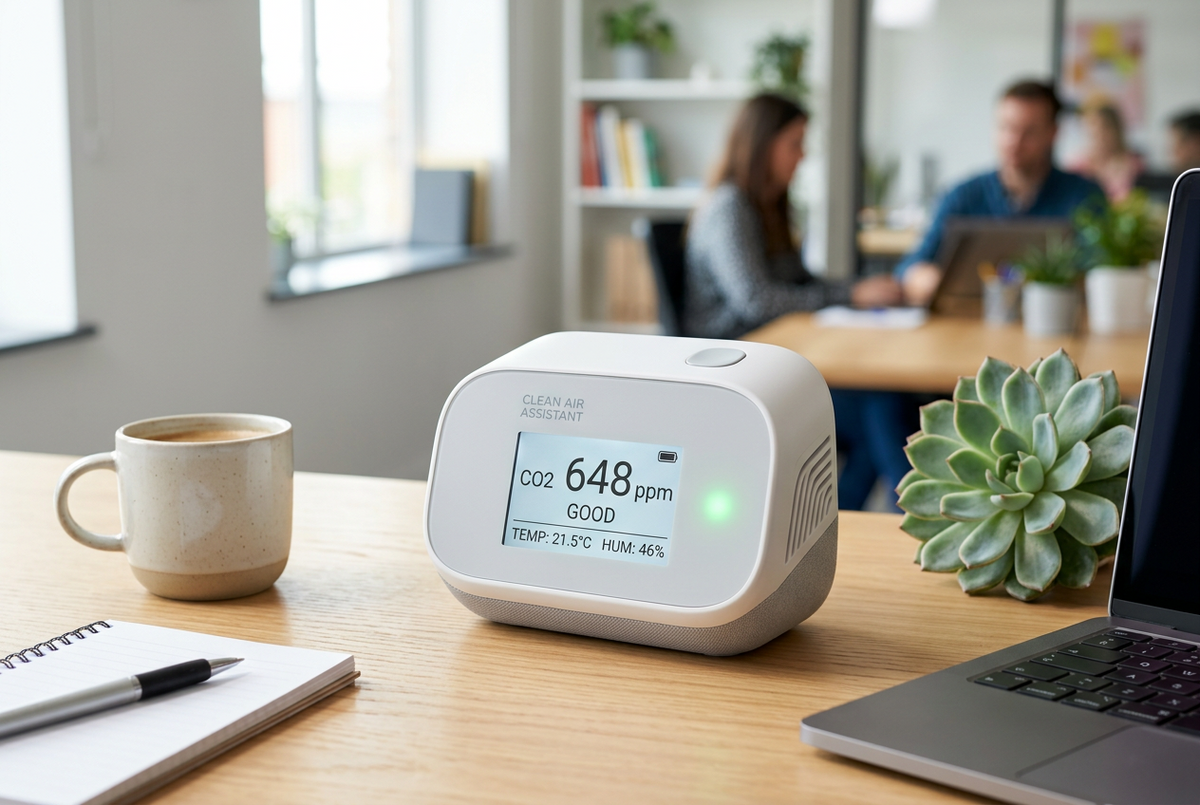
You close the door, turn off the light, and spend the next seven or eight hours breathing the same small volume of air. By morning, that room can hold two or three times as much carbon dioxide as the air outside. Most of us never notice, because CO2 at these levels has no smell. But a growing body of research suggests it shows up in how well we sleep and how sharp we feel the next day.
Here's what the evidence says about bedroom CO2, which number to aim for, and how to get there without spending a fortune.
The short answer
Keep bedroom CO2 below 1,000 ppm through the night, and ideally below 800 ppm.
That's the conclusion of a 2025 review commissioned by ASHRAE (research project 1837-RP), led by researchers including Pawel Wargocki of the Technical University of Denmark. After examining studies that measured both bedroom ventilation and sleep, the authors concluded that CO2 from sleepers should stay under 1,000 ppm at minimum and preferably under 800 ppm, and that the outdoor air supply to bedrooms should be at least double what current residential standards require (Akimoto et al., 2025, Science and Technology for the Built Environment). They also flag that more research is needed to confirm this, which is a fair caveat to carry with you.
For context, outdoor air sits at roughly 400 ppm, and the Minnesota Department of Health notes that a properly ventilated room should stay under 1,000 ppm (MDH).
Why CO2 matters at night (and why it's really a proxy)
It helps to be precise about what CO2 is telling you. At the levels found in homes, CO2 is mostly a ventilation indicator: a measurable stand-in for everything else that builds up when a room isn't getting enough fresh air, including the other gases and odors people give off (researchers call these "bioeffluents"), moisture, and whatever is off-gassing from furniture and bedding.
That distinction comes from careful lab work. In a 2017 study, Zhang, Wargocki and colleagues exposed 25 people to air where CO2 had been raised to 1,000 or 3,000 ppm in two different ways: by adding pure CO2 to otherwise well-ventilated air, or by cutting ventilation so the occupants' own breath raised it. Pure CO2 produced no significant effects on perceived air quality, symptoms or thinking. Stale air at 3,000 ppm did: people reported more headache, fatigue and sleepiness, and performed worse on several cognitive tests (Zhang et al., 2017, Indoor Air).
An earlier study from Lawrence Berkeley National Laboratory did find decision-making scores dropping at 1,000 and 2,500 ppm of added CO2 compared with 600 ppm (Satish et al., 2012, Environmental Health Perspectives), though the authors themselves called for confirmation. The science on CO2 alone is unsettled. The science on poorly ventilated rooms is much clearer, and for a bedroom that's the practical question anyway: if the CO2 number is high, the air is stale.
What happens to a bedroom overnight
A sleeping adult keeps exhaling CO2 all night. In a small room with the door and window shut, there's nowhere for it to go, so the concentration climbs steadily for hours.
Two well-known studies show how big the difference can be:
- Fan on vs fan off. Researchers at the Technical University of Denmark studied students in identical dormitory rooms for two weeks. With an outdoor-air fan that switched on above 900 ppm, overnight CO2 averaged about 835 ppm. With the fan off, as if the window were closed, it averaged about 2,395 ppm and peaked above 3,000. On the better-ventilated nights, students spent a greater share of their time in bed actually asleep, felt more rested, and tended to do better on next-morning concentration tests (Strøm-Tejsen et al., 2016, Indoor Air, summarized by ASHRAE).
- Window or door open vs closed. In a Dutch study of 17 young adults, simply leaving a window or the bedroom door open brought average nighttime CO2 down from about 1,150 ppm to about 717 ppm. Self-reported sleep depth and one actigraphy-measured sleep measure differed significantly between the two conditions (Mishra et al., 2018, Indoor Air).
Both studies are small, and neither proves CO2 alone is the cause. But they point the same way, and they match what many people find the first time they put a monitor next to the bed: a closed bedroom routinely crosses 1,000 ppm well before morning.
A practical bedroom CO2 scale
These bands are a working guide built from the research above, not an official standard:
| Overnight CO2 | What it suggests |
|---|---|
| ~400–600 ppm | Close to outdoor air. Excellent. |
| 600–800 ppm | Well ventilated. The range the 2025 review prefers. |
| 800–1,000 ppm | Acceptable, but worth improving. |
| 1,000–1,500 ppm | Under-ventilated. Common with doors and windows shut. |
| Above 1,500 ppm | Stale air. Ventilation needs attention. |
Health agencies put the point where CO2 itself causes symptoms such as headache and dizziness much higher, at prolonged exposure above about 5,000 ppm (MDH). So a reading of 1,800 ppm in your bedroom isn't dangerous. It means the room isn't getting enough fresh air for good sleep.
How to lower CO2 in your bedroom
Start with the free fixes, then measure whether they worked.
1. Open the bedroom door
This is often the single biggest win, because it connects your bedroom to the rest of the home's air. In the Mishra study, an open door counted the same as an open window.
2. Crack a window, even slightly
A small gap can make a large difference. If outdoor noise, security, pollen or cold is a problem, try it for part of the night or in a neighboring room with the bedroom door open.
3. Run your ventilation, not just your heating or cooling
Many central heating and cooling systems recirculate indoor air without bringing in much outdoor air. If your home has a fresh-air intake, an ERV/HRV or a bathroom exhaust fan, running it overnight can help. Window AC units usually recirculate too, so don't assume they're refreshing the air.
4. Air out before bed
Ten minutes of cross-ventilation before you sleep resets the room close to outdoor levels, which gives you a lower starting point.
5. Mind the headcount and room size
Two people and a pet in a small room will raise CO2 roughly in proportion to how many of you are breathing. Smaller and more occupied rooms need more ventilation, not less.
One thing that won't help: an air purifier (here's what a purifier does and doesn't do). Purifiers filter particles (and some filter odors), but they don't remove CO2. Only fresh air does.
Don't forget the rest of the bedroom air
CO2 is the headline number for sleep, but it isn't the only one worth watching:
- Humidity. The US EPA recommends keeping indoor relative humidity below 60%, and ideally between 30% and 50%, to limit mold and dust mites (EPA). Bedrooms often drift high overnight from breathing alone, especially with windows shut in winter.
- Temperature. A review of thermal environments and sleep found that heat exposure, made worse by high humidity, tends to increase wakefulness and reduce deeper sleep stages (Okamoto-Mizuno & Mizuno, 2012, Journal of Physiological Anthropology). A slightly cool room usually beats a warm one.
- Fine particles (PM2.5). If you open a window near a busy road or during wildfire season, you may trade CO2 for smoke or traffic particles. The WHO's 2021 guideline for PM2.5 is a 24-hour average of 15 µg/m³ (WHO). This is the main reason to measure particles alongside CO2: it tells you when opening the window is a good idea and when it isn't.
Measuring it properly
You can't manage what you can't see, and CO2 is invisible by definition. A few tips for getting a trustworthy bedroom reading:
- Use an NDIR CO2 sensor. Non-dispersive infrared sensors measure CO2 directly (here's how NDIR CO2 sensors work). Cheaper "eCO2" readings estimated from VOC sensors are much less reliable for this job.
- Don't put it right next to your face. Your exhaled breath will spike the reading. A bedside table or shelf an arm's length or more from your pillow, at roughly bed height, gives a more representative picture of the room.
- Keep it away from the window and door. Otherwise you're measuring the draft, not the room.
- Look at the overnight trend, not one number. What you want to know is how high CO2 climbs by 4 a.m. and how quickly it falls when you change something.
What to look for in a bedroom monitor
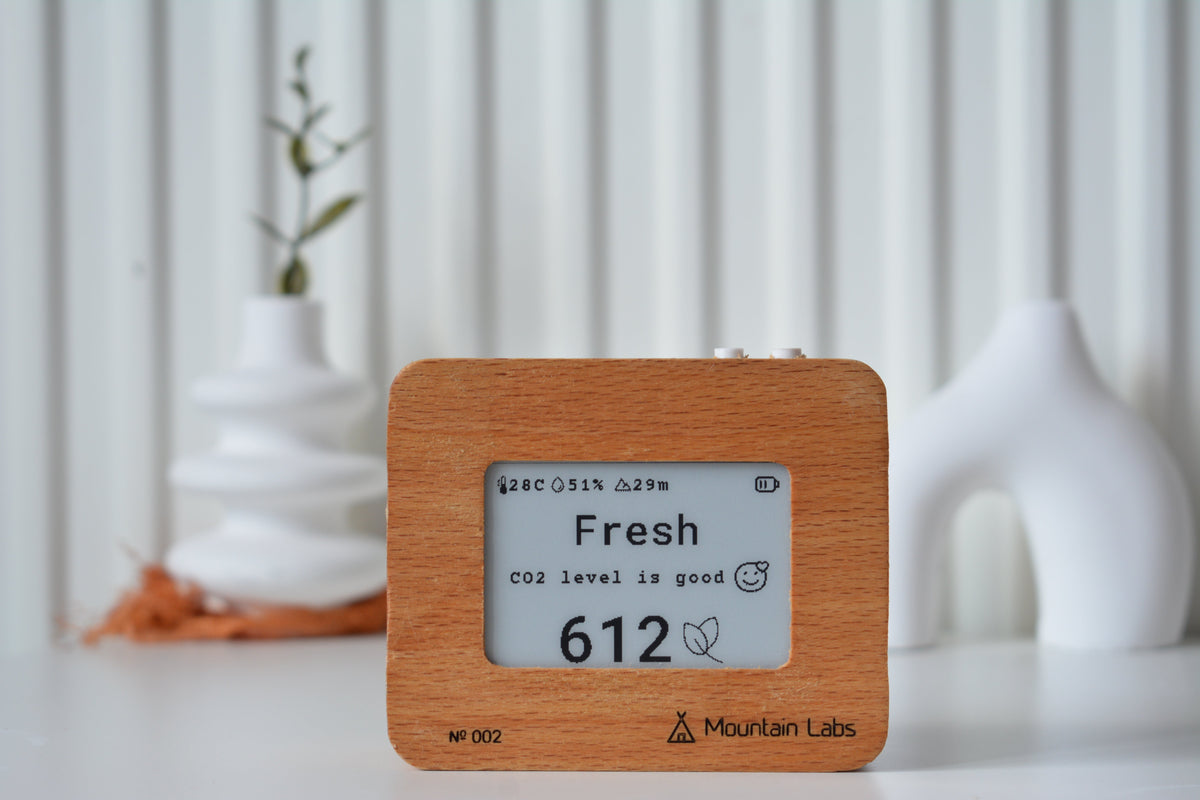
Bedrooms have requirements that living rooms don't. A bright glowing screen can disturb sleep, so an e-ink display, which shows readings without emitting light, is a good fit. You'll want on-device history, so you can see what happened overnight without reaching for your phone. And it helps if the monitor measures humidity, temperature and particles as well as CO2, so you can tell whether opening the window is actually improving things.
There are good options at different price points (see our guide to choosing a CO2 monitor for your home). The Aranet4 Home, for instance, is a well-regarded CO2 monitor with an NDIR sensor and e-ink screen that also reads temperature, humidity and pressure; its app is optional for viewing readings, though some settings can only be changed through it.
We designed our own monitor, Odak, with bedrooms very much in mind. It pairs an NDIR CO2 sensor with a laser particle sensor (PM1.0, PM2.5 and PM10), VOC, temperature, humidity and pressure, shows a 24-hour air-quality graph on an e-ink screen, and works entirely offline, with no app, account or cloud. That means nothing to set up and nothing transmitting from your nightstand. If you only want to track CO2, Odak Lite is our smaller, CO2-focused option.
The bottom line
- Aim for under 1,000 ppm overnight, ideally under 800 ppm.
- Treat CO2 as a fresh-air gauge: a high number means stale air, not poisoning.
- Open the door, crack a window, run your ventilation, then check that it worked.
- Watch humidity and particles too, so a fix for CO2 doesn't create a new problem.
Most people are surprised by their first night of bedroom data. The good news is that the fixes are usually free. Seeing the number is what makes them stick.
Want to see what your bedroom is really doing overnight? Meet the Odak Clean Air Assistant: CO2, particles, VOCs, humidity and temperature on an e-ink screen, with no app or cloud.

Leave a comment
This site is protected by hCaptcha and the hCaptcha Privacy Policy and Terms of Service apply.