

The short answer
For most homes in heating season, open windows wide for 3–5 minutes, several times a day, ideally on opposite sides of the home so air can cross through. That's the guidance from Germany's Fraunhofer Institute, which studies indoor air for a living: a short burst of strong airflow does more than a window left cracked all day, and it costs far less heat (Fraunhofer WKI).
"Several times a day" is a rule of thumb, though. A one-bedroom apartment with two people working from home needs more airing than a large house with one occupant who's out all day. The rest of this guide explains why winter air gets stale, how to tell when your rooms actually need fresh air, and how to do it without paying to heat the street.
Why indoor air gets worse in winter
Most American homes don't have a system that deliberately brings in outdoor air. The EPA notes that typical residential heating and cooling systems recirculate indoor air rather than pulling in fresh air, so homes rely on air leaking in through cracks and gaps (infiltration) and on opened windows and doors (EPA).
In summer, windows are open anyway. In winter they stay shut, and three things build up:
- Carbon dioxide (CO2) from breathing. Outdoor air sits at roughly 420–430 ppm (NOAA). A closed bedroom or home office with people in it can climb well past 1,000 ppm within hours.
- Moisture from showers, cooking, drying laundry and breathing. Warm, humid air meeting cold window glass is why you see condensation in the morning.
- Other pollutants from cooking, cleaning products, candles and new furniture, which have nowhere to go when the house is sealed.
The EPA's first recommendation for most of these is source control: remove or reduce the thing producing the pollution before reaching for more ventilation (EPA). But you can't stop breathing or showering, so some fresh air is unavoidable.
How to know when to open the windows
Use CO2 as your ventilation gauge
CO2 is the most practical signal for "this room needs fresh air," because it rises in step with occupancy and falls the moment outdoor air comes in.
There's no single official U.S. limit for homes. ASHRAE, the body that writes U.S. ventilation standards, is explicit that its residential standard (62.2) contains no CO2 limit, and that the often-quoted 1,000 ppm figure is not an ASHRAE requirement (ASHRAE position document, 2023). ASHRAE also cautions that CO2 is not an overall measure of air quality. It's a good indicator of how well a space is ventilated, not proof the air is clean.
For a practical yardstick, Germany's Federal Environment Agency (UBA) uses three bands (UBA hygienic guide values):
| Indoor CO2 | UBA assessment | What to do |
|---|---|---|
| Below 1,000 ppm | Hygienically safe | Nothing; air is being refreshed adequately |
| 1,000–2,000 ppm | Hygienically noticeable | Time to air the room |
| Above 2,000 ppm | Hygienically unacceptable | Ventilate now, and consider airing more often |
A simple routine: when a room passes about 1,000 ppm, open up until it drops back toward outdoor levels, then close again.
Why it's worth the effort
Stale air isn't just a comfort issue. In a well-known double-blind study at Harvard and Syracuse, office workers scored significantly lower on decision-making tests when CO2 was raised to around 950 ppm, with larger drops at 1,400 ppm (Allen et al., Environmental Health Perspectives, 2016). In fairness, the research isn't settled: ASHRAE's 2023 review describes the evidence on CO2's direct effects on health and performance as inconsistent. Either way, high CO2 tells you the room isn't getting enough fresh air, and everything else you emit indoors is building up alongside it.
Watch humidity too
The EPA recommends keeping indoor relative humidity below 60%, ideally between 30% and 50%, to discourage mold (EPA mold guide). In winter you can see both problems: rooms with showers, cooking or drying laundry run humid, while heated air elsewhere can drop toward the dry end. If your windows are fogging up or dripping every morning, humidity is too high for how cold the glass is, and airing out is one of the EPA's recommended fixes.
How to ventilate in winter without losing heat
Heat in a room is stored mostly in the walls, floors and furniture, not the air. Swapping the air for a few minutes doesn't drain that stored warmth, so the room recovers quickly once the windows are closed. Leaving a window slightly open for hours does the opposite: it chills the surfaces around it while exchanging very little air. That's the logic behind Fraunhofer's "brief and strong beats weak and continuous" advice (Fraunhofer WKI).
1. Purge, don't crack
Open windows fully for 3–5 minutes rather than tilting one open all day. In milder weather you can go longer; Fraunhofer suggests at least 10 minutes in summer.
2. Cross-ventilate
Open windows on opposite sides of the home (or open interior doors between them). A through-draft replaces the air far faster than a single window.
3. Turn the heat down while you air
Turn down the thermostat or close radiator valves in the room before opening windows, so the system isn't heating air that's about to leave. Turn it back up when you close up.
4. Air at the right moments
The best times are when moisture and CO2 peak:
- First thing in the morning, after a night of breathing in a closed bedroom
- Right after showering: the EPA advises running the bathroom fan or opening the window (EPA)
- During and after cooking, with the range hood on if it vents outdoors
- Mid-afternoon in a home office, when CO2 has had hours to accumulate
- Before bed, so you start the night with fresh air
5. Use your exhaust fans
Bathroom and kitchen fans that vent outside remove moisture and pollutants at the source and pull in some outdoor air at the same time (EPA). Check that yours actually vent outdoors, not into the attic or back into the room.
6. Check the air outside first
Ventilation only helps if the outdoor air is cleaner than the indoor air. The EPA advises caution when there's smoke or other pollution nearby (EPA). In winter that can mean wood-smoke from neighbors' fireplaces or heavy traffic at rush hour. A particle (PM2.5) reading inside that rises when you open the window is a good sign to wait.
7. Don't overcorrect into a cold house
The goal is fresh air, not a chilly home. The World Health Organization recommends a minimum indoor temperature of 18 °C (64 °F) in cold seasons to protect health (WHO Housing and Health Guidelines). Short purges help you stay above that while still clearing stale air.
A sample winter routine
For a two-person home with one person working from home, a realistic day might look like this:
| Time | Action | Why |
|---|---|---|
| 7:00 | Open bedroom and living-room windows wide, 5 min | Clear overnight CO2 and moisture |
| 7:30 | Bathroom fan on during shower, window open 5 min after | Remove shower steam |
| 12:00 | Air the home office, 3–5 min | CO2 has built up over the morning |
| 15:00 | Air the office again if CO2 is above ~1,000 ppm | Afternoon slump is often stale air |
| 18:30 | Range hood on while cooking, window open after | Cooking moisture and particles |
| 22:00 | Air the bedroom, 3–5 min, then close | Start the night near outdoor CO2 |
Treat this as a starting point. The right frequency depends on room size, how many people are in it, and how leaky your house is, which is exactly why measuring beats guessing.
Stop guessing: measure it
The simplest way to dial in your routine is to put a CO2 monitor in the rooms you use most, usually the bedroom and home office, for a week or two. You'll quickly learn how fast each room fills up and how long a purge takes to bring it back down. After that, many people find they only need to glance at the reading occasionally.
When choosing one, look for:
- An NDIR CO2 sensor. This is the sensing method that measures CO2 directly. Cheaper "eCO2" sensors estimate CO2 from other gases and are less reliable for this job.
- Humidity and temperature, so you can catch condensation risk and avoid overcooling.
- Particle (PM2.5) sensing if you live near traffic or wood-smoke, so you know when not to open the window.
- A readable display. If you have to open an app to check it, you'll check it less.
There are good options at different price points. The Aranet4 is a well-regarded CO2-focused monitor, while brands like Airthings and Qingping offer multi-sensor units, often paired with a smartphone app.
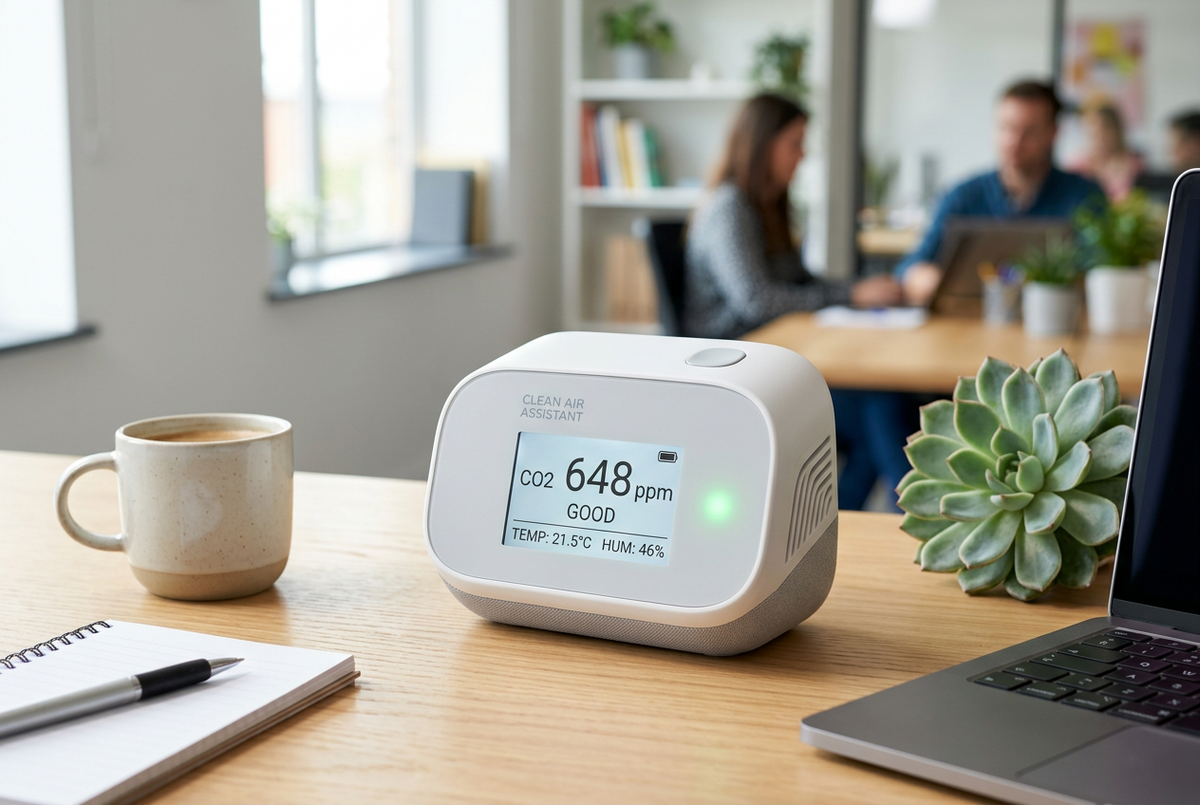
Our own Odak Clean Air Assistant was designed around this kind of routine. It pairs an NDIR CO2 sensor with PM1.0/PM2.5/PM10, VOC, temperature and humidity sensors, and shows everything on an always-on e-ink screen with a 24-hour air-quality graph, so you can see at a glance when a room has drifted and how quickly airing brings it back. It runs about a week per charge, which makes it easy to carry from bedroom to office as you learn each room's pattern. It works entirely offline, with no app, account or subscription.
Key takeaways
- In winter, open windows wide for 3–5 minutes, several times a day, rather than leaving one cracked.
- Cross-ventilate and turn the heat down while you air.
- Use CO2 as your cue: under 1,000 ppm is good; 1,000–2,000 ppm means it's time to air; above 2,000 ppm, ventilate now.
- Keep humidity between 30% and 50% and treat window condensation as a signal.
- Don't air out when outdoor air is smoky, and keep the home at 18 °C (64 °F) or above.
Want to see what your rooms are doing this winter? Meet the Odak Clean Air Assistant →

Leave a comment
This site is protected by hCaptcha and the hCaptcha Privacy Policy and Terms of Service apply.