
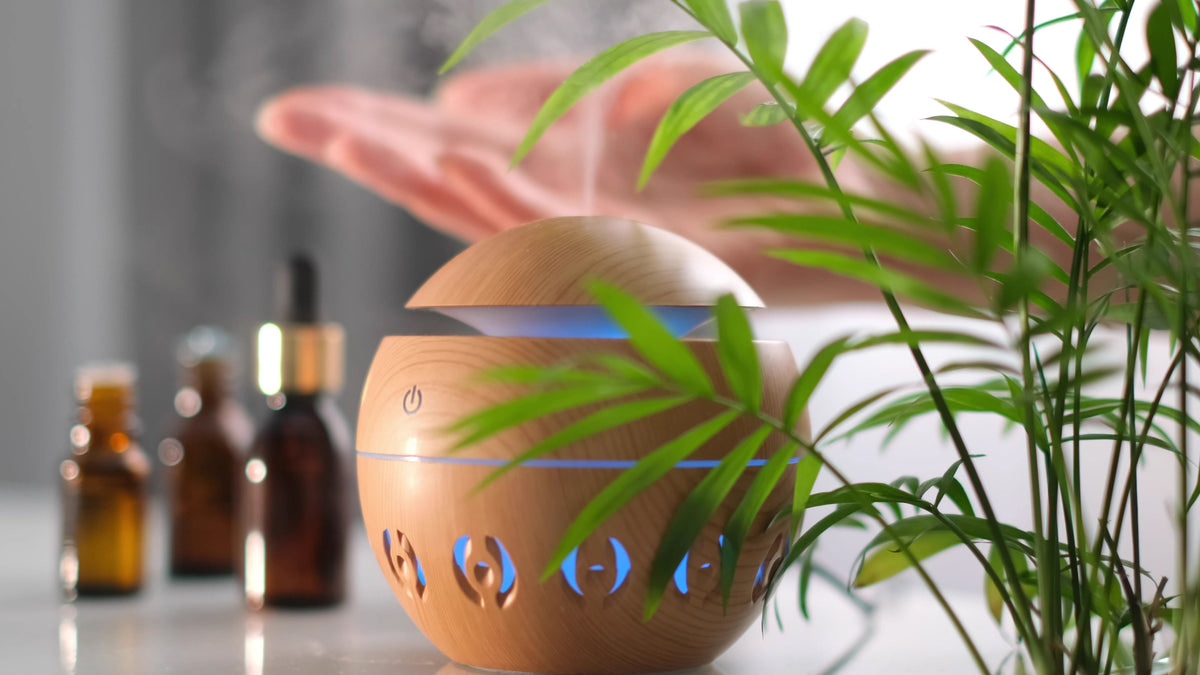
In winter, candles and essential-oil diffusers are two of the easiest ways to make a home feel warm and smell good. Both release something into a room that’s usually sealed up against the cold, with ventilation at its lowest. That’s why indoor-air researchers keep measuring them.
The short answer is yes, both affect indoor air, in different ways. Candles are a small combustion source: they release fine and ultrafine particles, some soot and, when scented, fragrance VOCs. Diffusers don’t burn anything. They release fragrance compounds that can form new particles in room air, and ultrasonic models can also add mineral dust from tap water. How much either one matters depends mostly on the product, how you use it and how well the room is ventilated.
Candles: what a flame puts into the air
Fine and ultrafine particles
Most particles from a candle flame are tiny. A review of French ADEME research, summarised by EPFL’s Human-Oriented Built Environment Lab, notes that most are smaller than 100 nanometres and some are below 10 nm (EPFL HOBEL, 2023). That’s far below the 2.5-micrometre cut-off for PM2.5.
The Danish Environmental Protection Agency measured particles in 56 Danish homes and found that candles accounted for up to 60% of indoor ultrafine particles on average (Danish EPA, 2017). Particle mass rises too. A 2025 study in Scientific Reports measured real homes and found PM2.5 and PM1 still elevated 3 m and 6 m from burning scented candles (Yun et al., 2025).
Soot
Soot is the black carbon you see as a smoky tail or a dark ring on a jar. It comes from incomplete combustion, typically when the flame can’t get enough oxygen for the wax it draws up. The Danish EPA found that sooting candles emit roughly 30 to 70 times more carbon particles than candles with a steady, non-sooting flame. Its top recommendation was to choose candles that burn that way. For candles, flame behaviour can matter more than brand or wax type.
Fragrance VOCs, NO2 and CO2
Scented candles add fragrance to the wax. A Fraunhofer WKI chamber study tested paraffin, soy, palm and stearin candles with five fragrances plus unscented versions. Total VOC emissions ranged from about 70 µg per candle per hour (unscented paraffin) to over 14,000 µg/h (one fruit-scented paraffin) (Salthammer et al., 2021, Environment International). The flames also gave off small amounts of nitrogen dioxide, and, like any combustion, they add CO2. One caveat: candle trade associations co-funded this study, and industry representatives co-authored it, so read its conclusions with that in mind.
Scented vs unscented, soy vs paraffin
Unscented usually beats scented. In the Fraunhofer data, scented candles often released many times more VOCs than the same wax unscented. The ADEME work summarised by EPFL also reports more soot and NOx from scented candles.
Wax type matters less than labels suggest. The ADEME work found lower emissions from natural waxes than from paraffin. But in the Fraunhofer chamber, the highest PM2.5 emission rate came from a scented soy candle, and unscented stearin had the lowest. Fragrance load and flame quality generally matter more than the wax.
Lead wicks are banned in the US. The Consumer Product Safety Commission banned candles with lead-cored wicks in 2003 (CPSC).
Diffusers: no flame, but not emission-free
“Diffuser” covers several products. Ultrasonic diffusers vibrate a mix of water and essential oil into a fine mist. Nebulizing diffusers atomise undiluted oil. Reed diffusers and wax warmers let fragrance evaporate on its own or with gentle heat. None of them burn anything, so there’s no soot. Researchers have still found two ways they affect indoor air.
Fragrance chemistry: terpenes plus ozone make new particles
Many essential oils and fragrances are rich in terpenes, such as limonene in citrus oils and the compounds found in pine and eucalyptus. A University of Toronto chamber study ran an ultrasonic diffuser with lemon, lavender, eucalyptus and grapeseed oils. In just 15 minutes, the diffuser released milligram quantities of VOCs such as d-limonene and eucalyptol (Schwartz-Narbonne, Du & Siegel, 2021, Indoor Air).
Indoors, terpenes react with ozone that drifts in from outside. That reaction forms new ultrafine particles, called secondary organic aerosol. A Berkeley Lab chamber study of terpene-rich household products measured PM1 levels from about 10 to over 300 µg/m³ once ozone was present. More ozone and less ventilation both increased particle formation (Coleman et al., 2008, Atmospheric Environment).
The same chemistry applies to flame-free wax warmers. Purdue University researchers measured scented wax melts in a test house and found they released large amounts of terpenes and formed many nanoparticles. Particle formation was comparable to, or higher than, that from burning candles. An unscented wax melt didn’t produce the effect (Purdue Engineering, 2025). A related Purdue study found that lower ventilation increased how much of these terpenes people inhaled (Liu et al., 2024, Building and Environment).
Ultrasonic mist: the tap-water problem
Ultrasonic diffusers work like small ultrasonic humidifiers, and that brings a second issue. The mist carries whatever is dissolved in the water. When the droplets evaporate, minerals are left floating as fine particles. In the Toronto study, running the diffuser with tap water instead of deionised water gave a fivefold increase in PM1. The oils emitted particles too, at rates that ranged widely from oil to oil.
Humidifier research points the same way. A University of Alberta study found that an ultrasonic humidifier filled with tap water produced fine particle levels the researchers compared to a polluted city, and that PM2.5 spread from one bedroom through the whole house. Distilled water produced essentially none (University of Alberta, 2020). The US EPA advises using low-mineral water such as distilled in ultrasonic units, and cleaning them regularly so they don’t spray microorganisms into the air (EPA).
This matters if you use a monitor. Mineral particles show up as PM2.5 on optical sensors, so a diffuser running on tap water can push readings up even when nothing is burning.
How worried should you be?
Context helps. The World Health Organization’s 2021 guidelines set PM2.5 limits of 5 µg/m³ as an annual average and 15 µg/m³ over 24 hours, and note that no safe threshold has been identified (WHO). The Danish EPA modelled annual PM2.5 exposure from regular use of well-behaved candles at under 1 to about 13 µg/m³, depending on candle type and how heavily they’re used. A sooting candle scenario was far higher.
The overall picture: an occasional unscented candle with a clean flame, or a diffuser used briefly with distilled water in a ventilated room, adds relatively little. Several scented candles burning for hours, a diffuser running all evening on tap water, or both together in a closed bedroom are a different matter. People with asthma or other respiratory sensitivities may want to be more cautious and talk to their clinician.
Winter makes all of this worse. Windows stay shut, and fragrance often shares the air with cooking and wood-burning stoves.
Practical ways to keep the cosy without the haze
For candles
- Watch the flame. You want a tall, steady flame. Flickering, smoking or a dark tail means incomplete combustion.
- Trim the wick to about 5–6 mm (¼ inch) before each burn, and keep candles out of draughts from vents, fans and doors.
- Prefer unscented, and burn fewer at once, especially in small rooms.
For diffusers
- Use distilled water in ultrasonic diffusers, and clean the tank as the manufacturer recommends.
- Run them in short sessions rather than all evening. Use less oil, and be aware that citrus and pine-type scents are among the most terpene-rich.
- Keep them out of bedrooms overnight. The same goes for candles, for fire safety as well as air quality.
For both
- Ventilate during and after. A short burst of window ventilation clears the room quickly. More air exchange also slows the terpene–ozone chemistry.
How to see the effect in your own home
Most of what candles and diffusers release is invisible, so it’s easy to underestimate. A home air-quality monitor lets you watch it happen, and that’s often enough to change habits.
Know what you’re measuring. Most consumer monitors use laser (optical) particle sensors that report particle mass as PM1, PM2.5 and PM10. They don’t count the very smallest ultrafine particles well, so treat the reading as a reliable trend indicator rather than a full particle count (how laser particle sensors work). A VOC sensor adds a second signal for fragrance. CO2-only monitors such as the Aranet4 Home are excellent for judging ventilation, but they won’t show smoke or fragrance.
Our own Odak Clean Air Assistant combines a laser PM1.0/PM2.5/PM10 sensor, a MOX VOC sensor and NDIR CO2 in one device. Its 24-hour AQI graph makes a candle or diffuser evening easy to spot the next morning. It works fully offline with no app, account or subscription.
Try a simple experiment. Note your PM2.5 and VOC readings, then run your usual diffuser for half an hour, first with tap water and then with distilled. Do the same with a candle, opening a window for ten minutes after each. The before, during and after readings will tell you more about your home than any general study.
The bottom line
Candles and diffusers both affect indoor air quality, but how much is largely in your control. For candles: choose a steady flame, unscented wax, a trimmed wick and no draughts. For diffusers: use distilled water, short sessions and less oil. For both: ventilate afterwards. Be sceptical of “non-toxic” and “clean-burning” labels on scented products, flame-free ones included. And if you want to know rather than guess, measure.
See how the Odak Clean Air Assistant tracks particles, VOCs and CO2, with no app required →


Leave a comment
This site is protected by hCaptcha and the hCaptcha Privacy Policy and Terms of Service apply.